
The Midnight Toast: 10 Nordic Glasses, Coolers and Carafes
From the first Advent dinner to the last chime of the year, the glass cabinet does the work. Ten Nordic pieces, in stock across all four regions.
Read More →A plastic bottle and a juice carton undo a laid table faster than anything else on it. Ten Nordic carafes and jugs for water, juice, milk and gravy.
Most tables are let down by their own packaging. The cloth is clean, the candles are lit, the plates match, and in the middle of it stands a plastic bottle with a supermarket label facing the guests, next to a carton with a torn corner. It is the one part of the setting nobody chose. For most of the year that hardly registers. From now until the middle of January, when the table is laid more often and people stay at it far longer, it is the easiest thing in the room to put right.
Water looks better in glass, and it stops being an afterthought once somebody has to fill something. Milk from a jug is a different proposition from milk in its own carton. Gravy in porcelain can go round the table twice without anyone leaving their seat. The ten below run from clear Swedish glass to speckled Danish stoneware, they are in stock in the UK, Germany, Norway and Denmark, and every one of them can be compared across the shops on ScandiDeals.
⸻
Start with the one that does nothing clever. The Orrefors Enjoy water carafe is clear glass, eighty centilitres, narrow enough to stand between two place settings without taking a plate's worth of room. The top is cut away on a slant so the pour leaves from one side only, which is what keeps the last glass from running down the outside. No lid, no mechanism, nothing to wash separately. This is the carafe you fill without thinking and refill three times in an evening.

⸻
For a table of eight, a litre and a half saves a dozen trips to the tap. The Kosta Boda Picnic carafe holds a little over that in a heavy-based glass cylinder, with a cork pressed into the top and a short spout angled out of the shoulder. The pour comes from the spout while the cork stays where it is, so nothing gets in and nothing slops out when it is carried through from the kitchen.

⸻
Smoked glass does something useful in a dark room: it holds candlelight instead of vanishing into the cloth. The Ferm Living Ripple carafe is grey through the body, with close vertical ribbing over the lower half and a plain cylindrical neck above it. The ribbing is partly grip and partly optics: light breaks up as it passes through, so the carafe reads as an object rather than a container of water.

⸻
The argument for a lid is the fridge. The Rosendahl Grand Cru carafe is clear glass with faceted sides near the base, finished with a soft sand-coloured collar and a flat lid that sits down into the neck. Water keeps overnight without taking on the smell of whatever else is in there, and comes straight from the shelf to the table in the morning. The collar gives a wet hand something to hold.

⸻
Not everything on the table has to be quiet. The Muurla O carafe is a flattened body of clear glass with a round opening cut clean through the middle and a small lip drawn out at the top. The hole is wide enough to take a hand, which is how it is carried, and it makes an otherwise invisible object read from across the room. At nearly a litre and a half it is a serving piece, not a bedside one.

⸻
Glass is not the only answer. The House Doctor Pion carafe is stoneware in a chalky off-white, flecked through with grey and rust, eighteen centimetres tall, with a straight body that steps in at the shoulder and a narrow lip above it. Opaque means you cannot see how much is left, which is a small price for the way it sits among ceramic plates. In summer it holds a few stems on a windowsill and stays there.

⸻
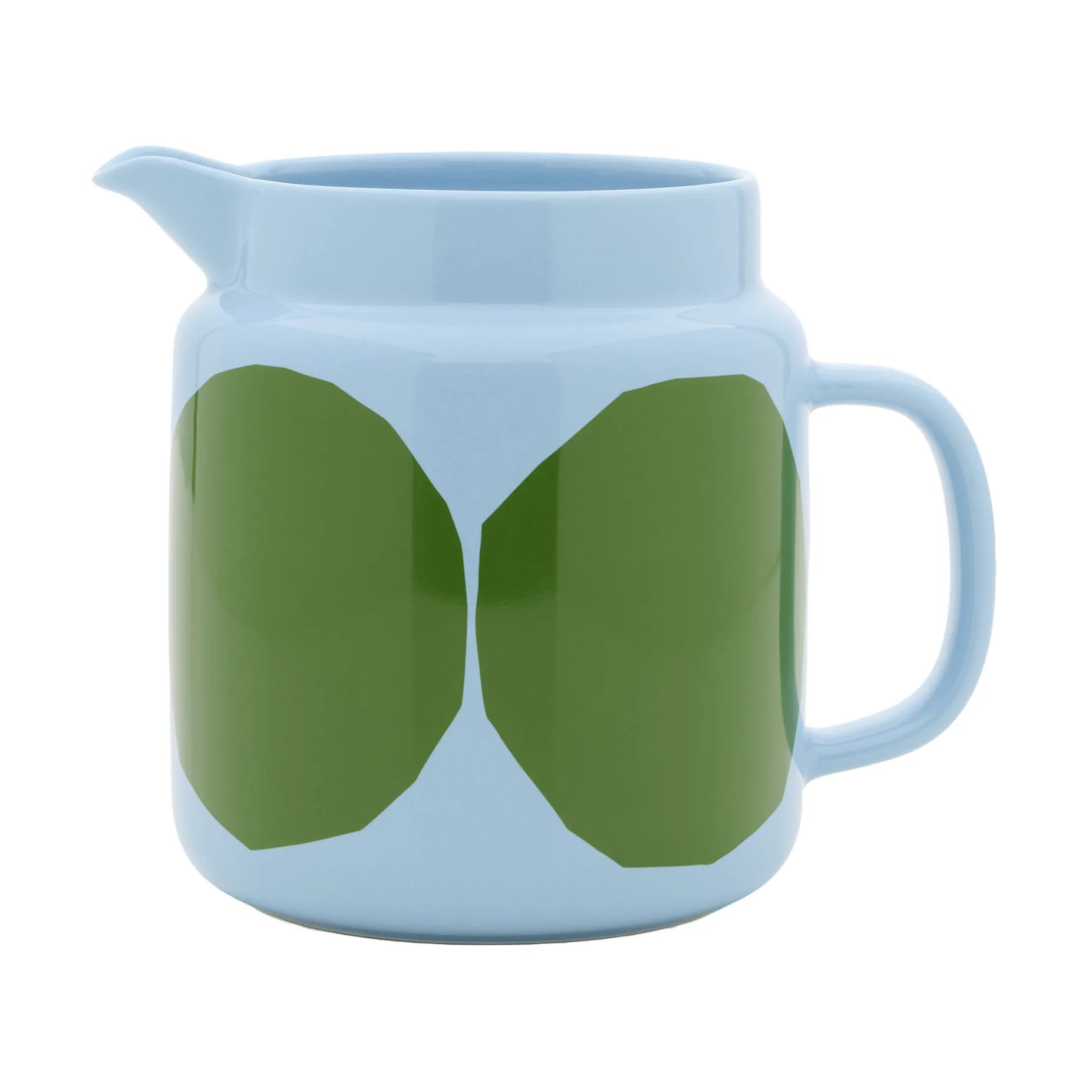
Pattern on a jug is a risk: the surface curves away and most prints break up on it. Kivet gets round that by being enormous. Two warm-green stones, one on each face, printed so large that the Marimekko Kivet jug carries only those two shapes against a pale blue ground. It holds a litre and a quarter, with a thick looped handle and a wide spout, and it decides the colour of a table rather than fitting in with it.
⸻
Finnish households buy Moomin ceramics for the children and then keep them. The Moomin Arabia Ancestor jug is the serious end of that shelf: a black body with a white doorway drawn on it, a yellow moon beyond, and the Ancestor, the shaggy figure out of Tove Jansson's stories, sitting on the threshold in the dark. Handle and lip are left white. A litre of milk or juice, and the drawing does the rest.

⸻
Twenty-five centilitres is a cream jug, which makes it the piece that gets passed hand to hand all afternoon. The Wik & Walsøe Slåpeblom jug is Norwegian porcelain, white, with pale blue blackthorn blossom scattered loosely over the body and a high curled handle that keeps a thumb clear of the cream. The base is gently fluted. Small pieces like this usually arrive as part of a service; this one is worth having alone.

⸻
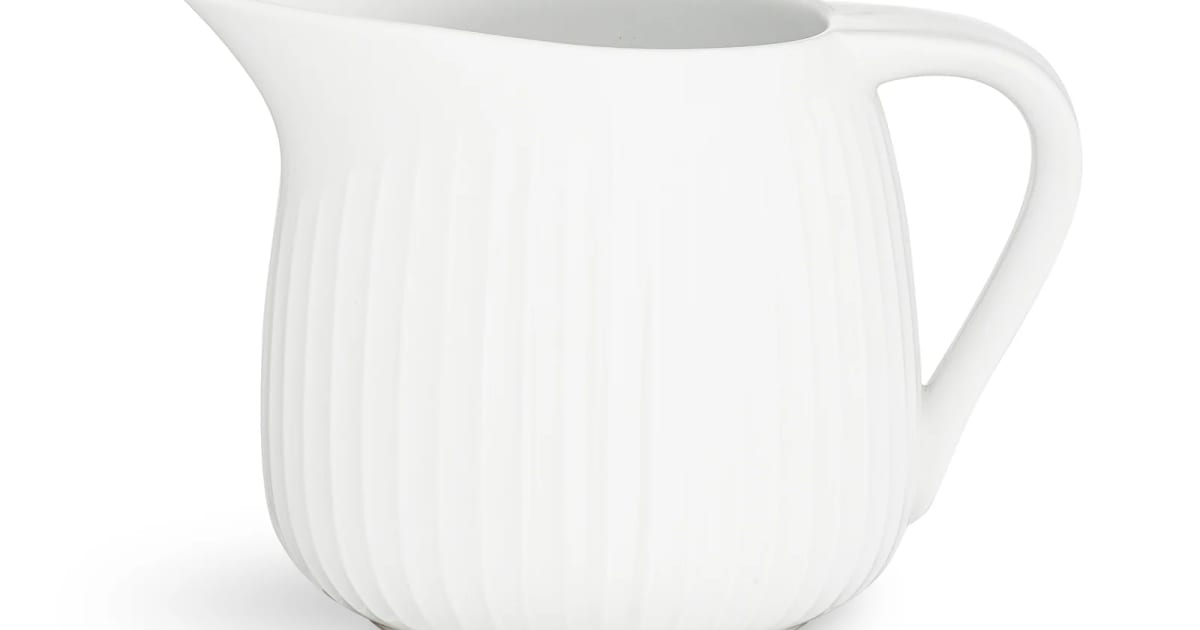
The last one is for the meal all of this is leading to. The Kähler Hammershøi sauce jug holds sixty-six centilitres, enough for a full table and the second helpings, and it is drawn low and broad so it pours without being tipped far. The fluting runs the height of the body in fine vertical bands, catching the light the way the rest of that range does. White glaze, a generous loop handle, dishwasher safe.

⸻
None of this is about drinking better. It is about what the table looks like for the four hours people are sitting at it, and about removing, permanently, the small irritation of a label facing the wrong way. A carafe is one of the few pieces of tableware that cannot go out of date. It has one job, it has had the same job for a very long time, and the Nordic versions are drawn with that in mind.
If you buy one, buy the plain glass one and use it every day, not only when there are guests. If you buy two, make the second one ceramic, so there is something to pour milk and gravy from that has not been borrowed from the water. All ten are in stock in all four regions, and what they cost moves between the shops from one week to the next, so compare them on ScandiDeals before the table gets busy.

From the first Advent dinner to the last chime of the year, the glass cabinet does the work. Ten Nordic pieces, in stock across all four regions.
Read More →
Nordic December eating is rarely one hot dish at a fixed hour. It is a table that stays out, and bread, butter and cheese do most of the work on it.
Read More →
Early November is when the kitchen table stops being a surface and becomes a dining table again. Ten Nordic cloths, runners, mats and napkins.
Read More →