
Nordic Kids' Rooms: 10 Pieces That Survive Childhood
A child's room takes more wear than any other. Ten Nordic pieces built to come through it: birch, wool, felt, silicone and Finnish steel.
Read More →A child's half of the household arrives one piece at a time, usually in November. Ten Nordic pieces in porcelain, birch, wool and steel, made to be handed on.
A child's half of the household arrives one piece at a time, and most of it arrives in November. Somebody asks what to give, and the honest answer is rarely a toy. It is a plate that survives the floor, a blanket that goes everywhere for four years, a whisk small enough to hold, a chair the child can climb into without being lifted.
The Nordic countries are unusually good at this. Children are handed the same materials as everyone else — birch, wool, porcelain, steel — in smaller sizes and better colours, and the pieces are built to be passed on rather than grown out of. The ten below run from a tumbler that costs less than a coffee to a chair that will still be in the family in thirty years. All of them are in stock in the UK, Germany, Norway and Denmark, and every one can be compared across the shops on ScandiDeals.
⸻
The Finnish factory Arabia has been printing Tove Jansson's Moomins onto porcelain for decades, and this two-piece set is where most families start: a plate with a raised rim to push food against, and a straight-sided mug with a handle big enough for two fingers. The drawing runs the whole way round, so there is a treasure chest on one side and Little My climbing out of a hat on the other. The Moomin Arabia children's dinnerware goes in the dishwasher for years, and it teaches a child that things can break.

⸻
The idea is obvious once you have seen it work: give a child the tumbler with their own initial on it and the question of whose cup this is never comes up again. The letters are Arne Jacobsen's, from the alphabet he drew in the 1930s, and at this scale one black capital fills most of the side. The Design Letters Kids glass is light in a small hand and clear enough to show how much milk is left. It is also the easiest present an aunt ever bought.

⸻
Before cutlery there is the stage where everything is tested against gravity. This plate is shaped as a bird: a round body for the food, a wing-shaped second well for whatever has to be kept separate, and a beak and tail to grab. The base of the Done by Deer Birdee Stick&Stay plate grips the table, which is the entire argument for it. Twelve centimetres across, soft enough to be dropped, and a muted blue rather than the usual nursery brightness.

⸻
A knife, a fork and a spoon in stainless steel, each with a thick silicone handle twisted like a length of rope: pale mint, ice blue and chocolate brown. The twist is not decoration. It gives a hand that has not yet learned a grip something to hold, and it keeps the fork from rolling off the edge of a plate. The business ends of the OYOY Mellow cutlery set are ordinary steel, so a child is practising on the real thing.

⸻
December is when most Nordic children are first given a bowl of their own and told to get on with it. Three pieces in beech and cream silicone make that possible: a spatula for scraping the sides, a balloon whisk, and a short rolling pin with turned handles. Everything in the Nordwik baking set for children is cut to a length a six-year-old can actually control. It is the cheapest thing on this list and the likeliest to be used before the month is out.

⸻
Left-handed children spend years with scissors that seem not to cut, because the blades are crossed for somebody else. These are made the other way round: thirteen centimetres, blunt rounded tips, blades stamped stainless Finland, with Little My printed up the green handles. The Fiskars Moomin left-handed children's scissors cut paper properly, which is the difference between a child who makes things and a child who gives up.

⸻
Thirteen by twenty-seven and a half centimetres, white, with a row of Elsa Beskow's mushroom children sitting with their backs turned under red toadstool caps. The Children of the forest tray is exactly the size of a sandwich and a cup, which makes it the thing a child carries carefully to the sofa on a Saturday morning. When the carrying stage is over it holds keys by the front door.

⸻
A low rack in olive-painted wood with two sloped compartments and a cut-out handle at either end. Books stand with their covers facing forward instead of their spines, which is how a child who cannot yet read finds the one about the fox. The Nofred book holder sits on the floor rather than the wall, so books can be taken out and put back without anyone being asked. Tidying becomes something a three-year-old can do alone.

⸻
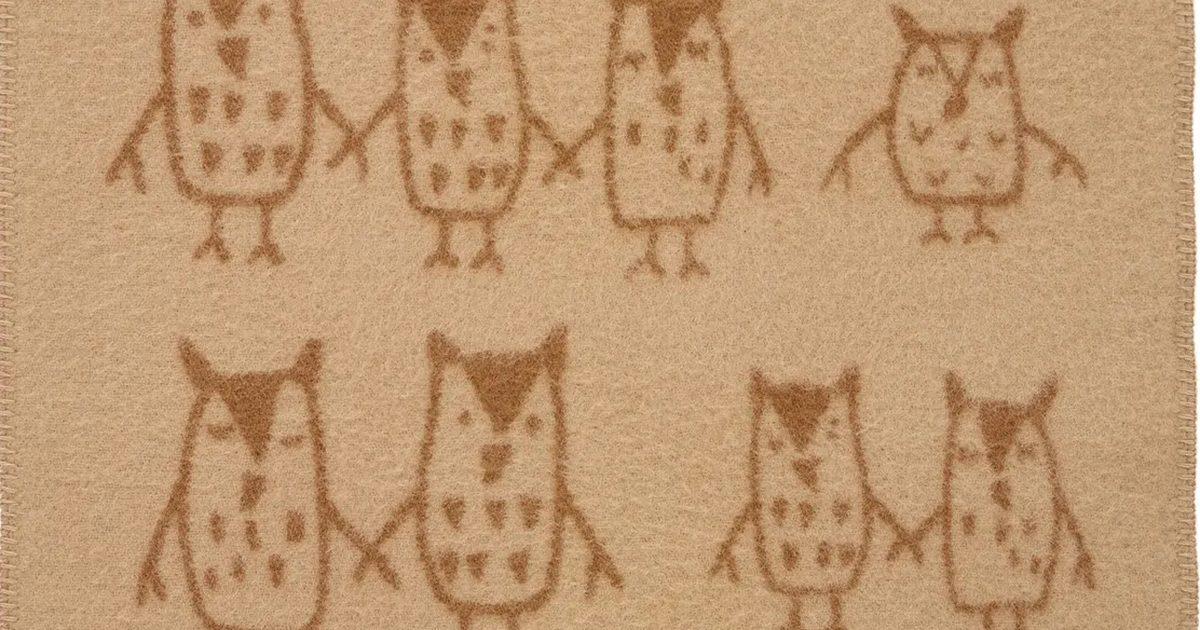
Klippan Yllefabrik has been weaving wool in southern Sweden since 1879, and the children's blankets are the warmest argument for the mill. This one is 65 by 90 centimetres in a soft taupe, with rows of owls holding wings right across it and a stitched edge that survives being dragged. The Klippan Hand in hand children's blanket is pram size: small enough to be carried everywhere, large enough to cover a lap on the sofa for years afterwards.

⸻
The expensive one, and the only piece here that will outlast the childhood it was bought for. Solid birch painted white, a spindle back, a seat dished just enough to hold a sitting child, and thirty-three centimetres from floor to seat. The Stolab Lilla Åland children's chair is a real chair at a child's scale, with no straps and no plastic. When it is outgrown it carries plants, then goes to the next family, which is rather the point.

⸻
The pattern across all ten is the same. None of them talk down to the child. The plate is porcelain, the blanket is wool, the blades are proper steel, the chair is joined the way an adult chair is joined, and every one of them is simply smaller. That is what makes them last: a child who is trusted with a real cup tends to carry it carefully, and the cup is still there when the next one needs it.
Buy slowly, and buy fewer. One good piece a year beats a shelf of things that will not survive the spring. If you are drawing up a list this month, compare the prices across the shops on ScandiDeals first — the same piece can sit at very different prices in the four countries, and the one nearest you is not always the cheapest.
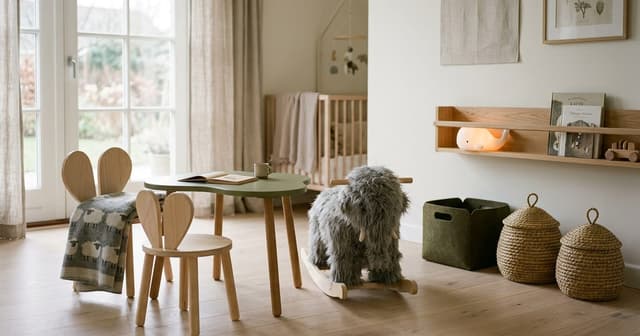
A child's room takes more wear than any other. Ten Nordic pieces built to come through it: birch, wool, felt, silicone and Finnish steel.
Read More →
The small figures come out of the box long before the tree does. Ten Nordic characters in porcelain, glass, turned wood, brass and wax.
Read More →
The tree comes in last of all, but the box is packed now. Ten Nordic ornaments in glass, wood, porcelain, brass and folded paper.
Read More →