
Buy Less, Buy Better: 10 Nordic Pieces Built to Last
The Nordic habit is not owning more, it is owning things that stay. Ten pieces in wool, cast iron, porcelain and steel, chosen for the decade after the purchase.
Read More →The swallows left weeks ago and the residents are at the window. Ten Nordic pieces about birds, from mouth-blown glass to a feeder for the first frost.
The swallows went weeks ago and the house martins with them. What is left at the end of October is the resident list: great tits, blue tits, a robin that has decided the garden belongs to him. This is the fortnight the feeder goes back up across the Nordics, on the reasoning that a bird which finds food in late autumn is a bird that stays all winter.
It is also the motif Nordic workshops have never tired of: birds blown in glass, turned in wood, printed on porcelain, lacquered in one flat colour. Eight of the ten pieces below are for indoors, two for the branch outside the kitchen window. All are in stock in the UK, Germany, Norway and Denmark, so you can compare what the shops are asking on ScandiDeals before the first frost.
⸻
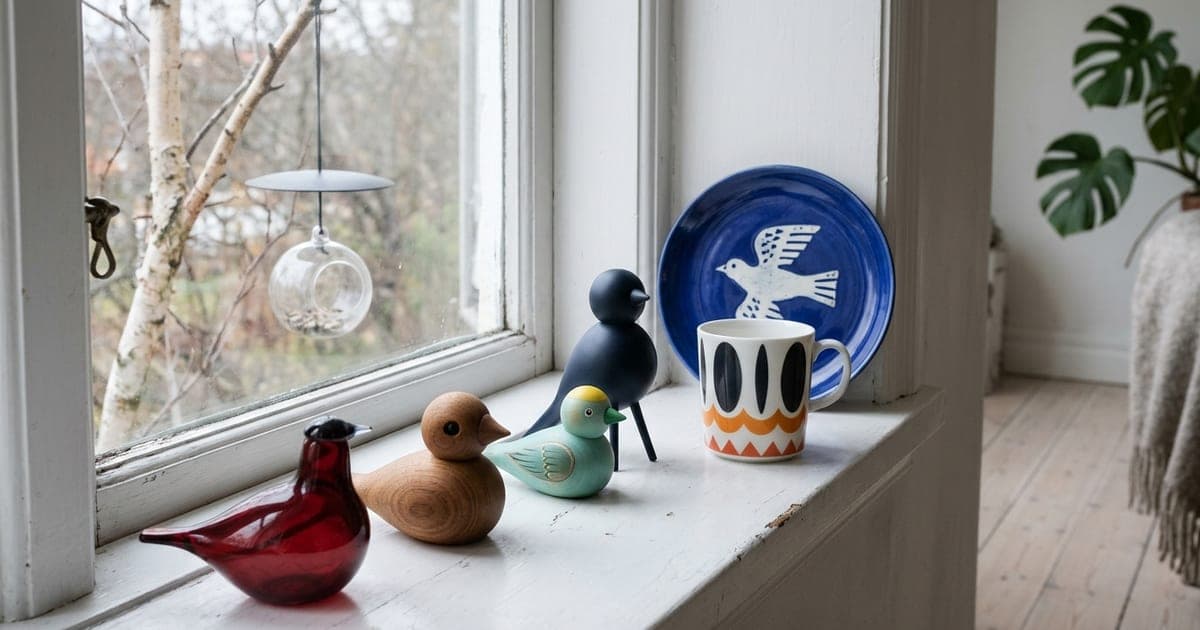
Oiva Toikka's glass birds have been in production for decades, and the little tern is one of the smaller ones: a deep red body that goes almost black where the glass thickens, with a dark head set over it like a cap. Each bird is mouth-blown in Finland and signed by the glassblower who made it, so no two hold quite the same colour. The little tern wants a windowsill where low sun can get behind it, at which point the red goes transparent.

⸻
A straight-sided tumbler of 46 centilitres with a small coloured bird set into the thick glass of its base. Full, it reads as an ordinary heavy glass. Drink most of it and the bird arrives, a trick that wears off on adults and never on children. Kosta Boda blows glass in the Småland forest, and the weight here is in the bottom third, where it keeps the glass upright on a crowded table. The New Friends tumbler is for water by the bed or juice at breakfast.

⸻
Kay Bojesen's wooden animals have become shelf furniture in Danish houses, and the songbird takes up the least room of any of them: a turned body in soft turquoise, a yellow crown, a green beak and one blue peg for a leg. The shape does a great deal with very little, being essentially two tapers and a dot. The Song Bird belongs on a desk or a child's shelf, and unlike the glass it survives being picked up by whoever wants a look.

⸻
Cut from solid teak and oiled rather than painted, so the grain runs the length of the body from breast to tail. A plump bird with a flat underside, a short beak and a single dark dot for an eye, in the small size, which sits in a closed hand. Handled teak darkens and evens out over the years, and the eye is the only thing anyone has added to the wood. The Twirling Bird looks best next to something made of glass.

⸻
A bird reduced until almost nothing is left: an upright body 13.5 centimetres tall, lacquered a dark blue that reads as near-black away from a window, with a small beak near the top of the curve and no other feature at all. No eye, no feet, no suggestion of a wing. It is the opposite approach to Toikka's, and the two sit together surprisingly well. The Little Bird works as a full stop at the end of a shelf of books.

⸻
Porcelain, 35 centilitres, carrying the band that gives the series its name and its date: two tall dark ovals, a scalloped orange line below the rim, a row of red and orange triangles under that. It takes a moment to resolve into birds, which is most of the pleasure. It is number one of a numbered set, so a cupboard builds up a mug at a time. The Birds 1967 mug holds a proper amount of coffee rather than a polite one.

⸻
Twenty-one centimetres across, with a white bird opening its wings over a cobalt blue ground, every feather drawn as a row of small scallops so the plate reads as pattern first and bird second. The blue is dark enough to carry bread, cheese and a knife without looking busy under them. The Selma plate is also one of the few plates worth standing on a dresser shelf on the days nobody is eating off it.

⸻
A square box of matches from the Swedish range ERNST, 11 by 11 centimetres, with a bird drawn on the lid in a handful of grey lines. A box this shape holds long matches and, more to the point, stays where it is put instead of migrating into a drawer with the batteries. The ERNST matchbox is the least expensive thing here and probably the most used: it lives by the candles from now until March.

⸻
The name explains the shape. A clear glass globe of seed hangs inside a wide black ring, 24 centimetres across, which does the work of a roof: rain runs off it and snow settles on top of it rather than in the food. The glass means you can see from indoors how much is left, which is the difference between a feeder that gets refilled and one that quietly empties. The Saturn feeder hangs from a branch or a hook on a wire.

⸻
A transparent bubble of recyclable plastic with a dark back, the seed lying in the curve of the floor and a thin wire bar below the opening for a bird to land on. Because it is clear, what you notice is the bird rather than the feeder, which is the argument for it over a wooden house on a pole. The Born In Sweden feeder is the smallest possible way to start, and sunflower hearts in it will bring tits within a week.

⸻
Ten pieces, one animal, and hardly any overlap between them: blown glass, turned teak, lacquered wood, printed porcelain, a box of matches and two feeders. A bird is the one piece of wildlife most people can watch from a chair, and it has been drawn so many times here that a single shelf holds several versions without any two looking related.
If you put a feeder up this week, the habit matters more than the hardware: birds spend the short days working out where the reliable food is, and once they have settled on a garden they come back, so keep it filled until spring. The glass and the wood get handed on rather than replaced. Compare what the shops in the UK, Germany, Norway and Denmark are charging on ScandiDeals first, because the same signed glass bird rarely costs the same in two countries.
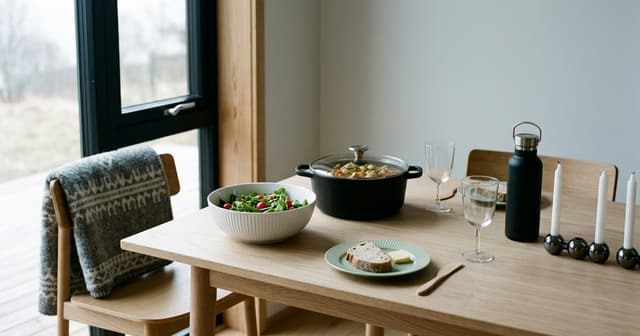
The Nordic habit is not owning more, it is owning things that stay. Ten pieces in wool, cast iron, porcelain and steel, chosen for the decade after the purchase.
Read More →
The famous Danish chairs and lamps cost a month's rent. The same houses make small things: ten Danish classics, from a cotton tea towel to a walnut dog.
Read More →
The week the clocks change is the week the first fire gets lit. Ten Nordic pieces for the hearth, from the wood carrier to the lidded ash bucket.
Read More →